.....for First Information & Pure Entertainment

........Empire State of Mind

>ads 728x90
Showing posts with label Wars. Show all posts

Monday, December 28, 2015

Iraq declares Ramadi liberated from Islamic State


Iraqi forces have been battling to retake Ramadi for weeks

The Iraqi city of Ramadi has been "liberated" from so-called Islamic State, the Iraqi military has declared.
Spokesman Brig Gen Yahya Rasul said forces had achieved an "epic" victory, adding the Iraqi flag had been raised over the government complex there.
The city's recapture is seen as a major reversal for the jihadist group. The jihadists had seized it in May, in an embarrassing defeat for the army.
Iraqi government forces had been fighting to retake it for weeks.
Troops managed to capture the government compound on Sunday, flushing out or killing Islamic State (IS) fighters and suicide bombers who had been holding out in the buildings.
The military said remaining IS militants have headed out to the north-east of Ramadi.
The operation to recapture Ramadi, about 55 miles (90km) west of Baghdad, began in early November.
It was backed by US-led coalition air strikes, but made slow progress, mainly because the government chose not to use the powerful Shia-dominated paramilitary force that helped it regain the mainly Sunni northern city of Tikrit, to avoid increasing sectarian tensions.
Share:

Syria fighters' evacuation from Zabadani 'under way'

Dozens of Syrian rebel fighters are being evacuated from the village of Zabadani near the Lebanese border under a UN-brokered deal.
A convoy of buses and ambulances has reached Zabadani to take the fighters, and some civilians, to Beirut.
The evacuation is part of a truce agreed in September covering Zabadani and two towns in the north which had been under siege from rebel forces.
About 300 families from those towns are also being given safe passage.
Also on Monday, at least 14 people had been killed and 90 wounded in two suicide bombings in the central city of Homs.
Reports said the blasts had hit the Zahraa neighbourhood of the city. It is predominantly inhabited by members of the Alawite sect to which President Bashar al-Assad belongs.
Map

Under siege

Zabadani has been under siege from pro-government forces backed by the Lebanese Shia militant group Hezbollah.
However, the two towns of Kefraya and Fuaa, in the northern province of Idlib, have been under siege from Sunni rebels.
The families from Kefraya and Fuaa are being taken to Turkey from where they will go to Lebanon.
The International Committee for the Red Cross (ICRC) said the Lebanese Red Cross, the Syrian Arab Red Crescent and the UN were all involved in the operation.
Monday's evacuations are the latest in a series of similar moves:
  • 26 December - An attempt to evacuate rebels, including some from the so-called Islamic State group, from the Palestinian refugee camp of Yarmouk outside Damascus collapses shortly before it was due to start
  • 9 December - Rebels leave Homs' Al-Wair district, the last one under their control
  • May 2014 - Hundreds of rebels leave Homs after months of government siege, under a deal brokered by Iran and facilitated by the UN
  • Members of Lebanon's Shia movement Hezbollah carry the coffin of a comrade killed in fighting near Zabadani 
Lebanon's Shia Muslim movement Hezbollah has seen fighters killed in fighting around Zabadani Zabadani is the last major rebel stronghold along the Lebanese border. Rebel fighters had been holding on, but faced almost certain defeat.
Localised ceasefires were at one point were proposed as one of the few ways out of the bloodshed and stalemate.
However, they have failed to build any real momentum, correspondents say.
Share:

Wednesday, December 23, 2015

Turkey Istanbul airport blast kills cleaner

A plane parked at a Turkish airport after an explosion nearby
Emergency staff were seen inspecting the plane after the blast

An explosion on the tarmac at Sabiha Gokcen airport in the Turkish city of Istanbul has killed a female cleaner.
The woman who died was working on a Pegasus airlines plane overnight when the blast took place. A colleague who was with her was wounded.
The cause of the explosion is under investigation, the airport says.
Armed police imposed tight security at the airport's entrance, Turkish media said, but flights were said to be running normally.
The woman killed, 30-year-old Zeyhra Yamac, died of head injuries.
No passengers were on the plane or nearby at the time, Pegasus said in a statement.
It said the explosion happened at 02:05 (00:05 GMT) on Wednesday. Although the cause of the blast was unknown, police were investigating whether it was a bomb, Dogan news agency reported.
Some witnesses claimed to have heard three consecutive explosions.
Located on the Asian facing side of Istanbul, Sabiha Gokcen is the ci
Share:

Saturday, December 19, 2015

Syria war: US welcomes 'milestone' as UN endorses peace plan

An injured child in a field hospital in Damascus in November, 2015
The agreement demands that all parties cease attacks against civilians

A UN plan for Syria is a "milestone" in the efforts to end the conflict there, says US Secretary of State John Kerry.
He said the plan gave Syrians a "real choice... between war and peace".
The resolution, passed unanimously by the UN Security Council, sets out a timetable for formal talks and a unity government within six months,
However, the resolution makes no mention of the future role of Syrian President Bashar al-Assad.
Western countries have called for his departure, but Russia and China say he should not be required to leave power as a precondition for peace talks.
Mr Kerry said Mr Assad had "lost the ability to unite the country" but he also said that demanding Mr Assad's immediate departure was "prolonging the war".
However, while Western and Arab nations accept that Mr Assad can be part of the transition, they also insist he must be gone at the end of it.
France's Foreign Minister Laurent Fabius said the idea of Mr Assad standing in elections was "unacceptable".
Syria's UN ambassador Bashar Jaafari said there was a "glaring contradiction" between outside countries talking about letting Syrians decide their future yet also insisting on replacing Mr Assad.
UN Security Council Resolution on Syria (No. 2254)
  • Calls for ceasefire and formal talks on a political transition to start in early January
  • Groups seen as "terrorist", including Islamic State and al-Nusra Front, are excluded
  • "Offensive and defensive actions" against such groups - a reference to air strikes by US-led coalition and Russia - to continue
  • UN chief Ban Ki-moon to report by 18 January on how to monitor ceasefire
  • "Credible, inclusive and non-sectarian governance" to be established within six months
  • "Free and fair elections" under UN supervision to be held within 18 months
  • Political transition should be Syrian-led
The resolution foresees talks between the Syrian government and opposition in early January.Russian Foreign Minister Sergei Lavrov said it would be possible to reach an agreement on a unity government for Syria within six months.
The plan sets out a timetable for UN-supervised elections within 18 months, and stresses that the Syrian people will decide the future of their country.
The plan also calls for a ceasefire, but there is also disagreement over which armed groups should be designated as terrorists and consequently excluded from any talks or ceasefire.
Actions against groups considered terrorist organisations would not be affected, allowing Russian, French and US air strikes against Islamic State to continue.
The agreement demands that all parties cease attacks against civilians.
The Syrian war, which is heading towards its fifth year, has killed more than 250,000 people and displaced millions more, the UN says.

Lyse Doucet, Chief International Correspondent, BBC News: "Hugely ambitious"

A man (with head bowed) walks in front of a burning building after a Syrian air force strike in Ain Tarma neighbourhood of Damascus January 27 2013 

A stubborn gridlock in the UN Security Council has long blocked any step towards a political resolution of Syria's devastating war. For years, everyone insisted there was no military solution. Nobody made much effort to achieve it.
The UN's first envoy Kofi Annan bitterly blamed the world body when he quit in 2012 after only one year in the job. His successor Lakhdar Brahimi frequently beseeched the Council to do more and often apologised to the Syrian people for failing them.
Now UN envoy Staffan de Mistura is tasked with organising Syria talks. This unanimous vote is a crucial step forward. But the goal of "credible, inclusive and non-sectarian governance" within six months is hugely ambitious.
President Assad's supporters will welcome a UN resolution that does not mention his role. Russia's growing diplomatic and military weight in this conflict helped achieve that compromise. But, for the opposition and their allies, it will continue to be the issue that will block progress every step of the way.
Share:

Friday, December 18, 2015

Powers meet to push ceasefire plan:Syria war

Free Syria Army fighter in front of burning vehicle (file photo)
There is a concerted diplomatic push to end the war, but serious divisions remain

World powers are meeting in New York to try to move forward a tentative plan to bring about a ceasefire in Syria.
Countries on both sides of the conflict are seeking to narrow considerable gaps which stand in the way of progress.
These include the fate of Syria's president, which groups could join talks with the regime, and which should be classed as terrorists.
The UN Security Council is expected to later vote on a text backing the broad plan for a truce and negotiations.
It follows a meeting of the so-called International Syrian Support Group (ISSG) which met in Vienna in November and agreed on the parameters of a political plan for the war-torn country.
There, 19 countries, including Syria's allies Russia and Iran, set a target of 1 January for the start of peace talks between the regime and the opposition.
The delegates signed a UN statement calling for a ceasefire to be agreed by 14 May 2016 and for free elections to be held a year later.
The BBC's Barbara Plett Usher in New York says it is the most concrete Syria peace plan yet, with a specific timetable. It is a broad outline, she says, that marks the minimum consensus of countries with a stake in the conflict.
But the process is propelled by a growing conviction that Syria's civil war has to be resolved in order to effectively combat the Islamic State group, our correspondent adds.

Sticking points

Building on the diplomatic momentum, Saudi Arabia, a staunch foe of Syrian President Bashar al-Assad, held a meeting earlier this month of dozens of disparate rebel and Syria opposition groups to try to forge a common approach to possible peace talks.
They agreed to a programme of six months of negotiations followed by the formation of a transitional body from which President Assad and his aides would be excluded.
However, Russia, Iran and Syria dismissed the meeting, saying the groups were unrepresentative and unacceptable.
There are still significant areas of disagreement between the two sides in the war and their backers.
One of the major sticking points is which rebel groups should be considered terrorist outfits and consequently excluded from any talks or ceasefire. Jordan has been tasked with drawing up a list.
The Syrian war, which is heading towards its fifth year, has killed more than 250,000 people and displaced nearly 12 million, the UN says.
Syrian schoolchildren walk past a poster of President Bashar al-Assad in Homs (8 December 2015)
The United States, which supports the Syrian opposition, wants a negotiated settlement based on the 2012 Geneva Communique, which calls for the formation of a transitional governing body. It says President Bashar al-Assad must go.
Russia, which launched an air campaign against Mr Assad's opponents in September, also calls for the implementation of the Geneva Communique. But it says Mr Assad's future is for the Syrian people, and not external powers, to decide.
Most of Syria's political and armed opposition factions now agree on the need for a managed transition, but they demand that the president leave at the start of it.
Bashar al-Assad says peace talks cannot begin until "terrorism" is eliminated, and that his departure is out of the question before elections are held.
Share:

Wednesday, December 9, 2015

US House votes to restrict visa-free travel after Paris attacks

Passengers wait in line to use the Automated Passport Control Kiosks set up for international travelers arriving at Miami International Airport
US officials fear European extremists could try to enter the country to launch an attack
The House of Representatives has voted to tighten visa-free travel to the US following the Paris attacks.
The measures would bar people who travelled to Iraq and Syria after March 2011 from the visa waiver programme.
People who have visited Iran and Sudan - which the US accuses of supporting terrorism - would also need a visa.
The White House-backed bill was proposed because the Paris attackers could have travelled to the US without a visa.
Republican presidential candidate Donald Trump has called for far greater restrictions, proposing that all Muslims be barred from entering the US until further notice.
But his comments - made after a deadly mass shooting in California by Islamist sympathisers - have been condemned by politicians from across the political spectrum.

'Abundance of caution'

The House voted 407 to 19 in support of the proposed change to visa-free travel.
"In an abundance of caution, we will now require those individuals to apply for a visa and go through the formal visa screening process," said House Republican Candice Miller, the bill's main sponsor.
There are 38 nations currently included in the US Visa Waiver Program (VWP).
US officials say about 5,000 Europeans, including many from VWP nations, have travelled to Syria and Iraq to fight with extremist groups such as the so-called Islamic State and pose a risk to the US.
If the bill passes through the Senate and is signed into law, it would also require all travellers arriving in the US under the VWP to have electronic passports containing biometric data from next April.
The bill also calls for countries participating in the VWP to share more information about suspected terrorists and criminals.
Share:

Syria conflict: Number of foreign fighters 'doubled in 16 months'

File photo of fighters from the so-called Islamic State group
The report says the number of foreign fighters has continued to rise despite governments' attempts to stop them
The number of foreign fighters in Syria has gone up from 12,000 to at least 27,000 since June 2014, according to a new report by a security consultancy.
The report from the Soufan Group says Arab countries supply the greatest number of recruits.
Outside the region, recruitment has risen markedly in Western Europe and Russia and Central Asia, it says.
The report says the average rate of returnees to Western countries is now at about 20-30%.
This presents "a significant challenge to security and law enforcement agencies that must assess the threat they pose," it says.
"In the countries with the largest flows, recruitment to the Islamic State has become more focused and localised, with fewer people just leaving on their own; family and friends are playing a greater role," the authors say.
They claim that the recruits for the so-called Islamic State and "other violent extremist groups" come from at least 86 countries.

They say that the largest single group of foreign fighters is Tunisians, numbering some 6,000.
The second-largest is from Saudi Arabia, which the report puts at about 2,500, followed by Russia (2,400), Turkey (2,100) and Jordan (2,000).
About 5,000 fighters come from EU countries, with some European countries contributing a "disproportionate percentage".
The report cites official figures indicating that about 1,800 individuals had left France to join the fighting, with 760 each from the UK and Germany, and 470 from Belgium.
Based on these estimates, more than 3,700 of the EU fighter contingent come from just four countries.
However, the authors say recruitment from North America has remained largely flat and that "recruitment within the Americas has been mostly reliant on social media, particularly in the initial phases of the process".
"We have to find better ways to address the Isis [Islamic State] appeal," Richard Barrett, a former head of global counter-terrorism at Britain's MI6 intelligence agency who contributed to the report, told Reuters.
"The Leytonstone rebuke 'You ain't no Muslim, bruv' does far more to undermine Isis than dropping bombs on Raqqa," Mr Barrett added.
Share:

Syria crisis: Rebels 'leave Homs' under truce

A destroyed building in the old city of Homs in Syria
Homs has been a key battleground throughout the Syrian crisis
Syrian rebels have begun evacuating the last area they hold in the city of Homs under a ceasefire deal reached with the government, a monitoring group has said.
The deal means the entire city returns to government control.
Those leaving are due to go to areas of Idlib province still in rebel hands.
Homs, in central Syria, was once dubbed the "capital of the revolution" and saw some of the first protests against President Bashar al-Assad, in 2011.
The first bus has left the rebel-held area of al-Waer in Homs, the Syrian Observatory for Human Rights said.
About 800 people, including rebel fighters and civilians, are due to leave throughout Wednesday, the observatory said.
Under the UN-backed ceasefire, food aid has reached the neighbourhood for the first time in nearly a year.
Ahead of the deal, the Syrian authorities said they released 35 opposition fighters detained in Homs.
"We wish for the best," said one resident. "What do we want but safety?"
A significant deal: Lyse Doucet, BBC News, Homs
The Al Waer neighbourhood of Homs, in Syria 
Al-Waer is the last rebel-held area of Homs
This very sensitive and significant deal has been reached after more than two years of sporadic negotiations.
Under the first phase of the agreement, hundreds of fighters, including those linked to al-Qaeda, will leave the besieged neighbourhood.
More moderate groups who have accepted the ceasefire will remain in al-Waer for the moment.
Syrian activists criticise such deals as surrenders forced by punishing blockades.
But the Syrian government, which has concluded similar deals in other areas, sees them as the best way to end the fighting on its own terms. And in some areas they have allowed some groups to keep their weapons and some control over their own communities.
Homs, Syria's third-largest city, has long been of geographic, strategic and economic importance. Before the uprising its population was estimated at 1.5 million.Protests erupted in the city in the early days of the revolt against President Assad in 2011.
A map showing Homs and Idlib province, Syria
Soon, thousands of Homs residents were taking part in demonstrations despite a brutal crackdown by security forces and pro-Assad militiamen that left dozens dead.
But in 2012 the Syrian military began a major operation to retake the city, bombarding rebel-held areas, an assault that trapped thousands of civilians.
Last year a UN-brokered deal saw rebels pull out of one of their last remaining strongholds, the Old City.

Share:

Venezuela election: Opposition 'supermajority' confirmed


An opposition supporter holds a Venezuelan national flag during a celebration in San Cristobal
Opposition supporters have been celebrating their side's victory
Venezuelan electoral authorities have confirmed that the opposition has won a key two-thirds majority, enabling it to challenge President Nicolas Maduro.
The opposition said it would work to release jailed opposition leaders and address the country's economic crisis.
Mr Maduro has announced a cabinet reshuffle but vowed to veto any amnesty law for jailed politicians.
The election result is the worst for the Socialist movement founded by late leader Hugo Chavez in 1999.
The majority means the Democratic Unity coalition can now make sweeping changes, including calling a possible referendum on Mr Maduro's leadership.
It also wants the release of one of its leaders, Leopoldo Lopez, who was given a 13-year prison sentence for inciting violence - a charge critics say was politically motivated.
But Mr Maduro said he would block any amnesty law.
"The murderers have to be prosecuted and have to pay," he said in a televised address.
He said his Socialist Party would hold an "extraordinary congress" to find out what went wrong at the election.
The opposition meanwhile warned of looming food shortages for Venezuelans.
"We urge the government to stop crying and start working," opposition leader Jesus Torrealba said.
"We're just a few weeks away from a very serious problem in terms of food," he added.


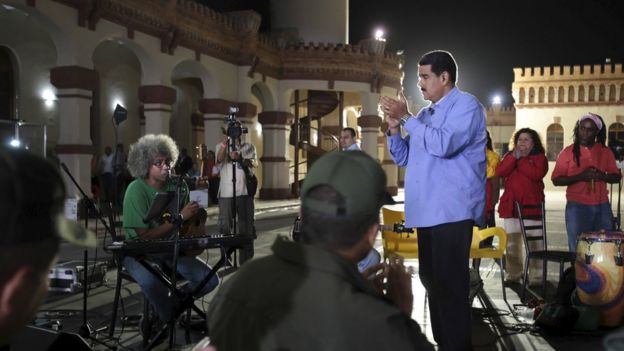
President Nicolas Maduro applauds during his weekly broadcast
sident Maduro has announced a cabinet reshuffle
The elections were widely seen as a referendum on President Maduro, the handpicked successor of Hugo Chavez, and the governing PSUV's socialist policies.
The opposition accused Mr Maduro's party of mismanaging the economy and of squandering the country's oil wealth.
Venezuela has been hit hard by the continuing low price of oil, its main export. It also has the continent's highest inflation rate.
Mr Maduro has blamed the situation on an "economic war" waged by the opposition.
The opposition also accused the government of increasing authoritarianism.

Why does the result matter?

  • It is the first time in 16 years that the PSUV is not in control in Congress - a serious blow to its socialist revolution
  • At 74.3%, voter participation was high, suggesting a sizeable proportion of the population backed change
  • The opposition will pose a serious challenge to the government's power to pass legislation
  • Jailed opposition leaders could be released if the opposition makes good on its promise to pass an amnesty law
  • It is another blow to left-wing policies in Latin America, coming two weeks after a centre-right candidate won in Argentina's presidential poll
The election result also gives stronger momentum to the opposition should it wish to call a referendum on Mr Maduro's future. This could take place only when his presidency reaches its halfway point in April next year.
However, some prominent opposition figures want to give Mr Maduro the opportunity to change policies they blame for the country's economic crisis.
"If Maduro doesn't change we'll have to change the government. But the opposition's response to the economic crisis right now can't be more politics," Henrique Capriles - who lost to Mr Maduro in the 2013 presidential elections - told AP.
The next presidential election is due in April 2019.

Venezuela's troubled economy

100%+
inflation level for 2015
  • -10% shrinking of GDP in 2015
  • -6% projected 2016 downturn
  • 18.1% projected 2016 unemployment rate
Share:

ISIS Targeting US Syrian Refugee Program, Homeland Security Chair Says

Syrian refugees (Photo: Reuters/David Ryder)
People gather to protest against the United States’ acceptance of Syrian refugees at the Washington State capitol in Olympia, Washington, November 20, 2015.
The Chairman of the House Homeland Security Committee said Monday that the U.S. intelligence community has found evidence that Islamic State fighters in Syria have attempted to infiltrate the Syrian refugee resettlement program to gain entrance into the United States.
Rep. Michael McCaul, R-Texas, spoke at National Defense University in Washington D.C. on Monday about the “state of Homeland Security” and argued that homeland security in the United States is at its “highest threat environment since 9/11.”
McCaul explained that he and members of the Homeland Security Committee were recently briefed by members of the intelligence community. As the U.S. government plans to resettle as many as 10,000 Syrian refugees in the next fiscal year, McCaul said that he was told by the intelligence community that ISIS fighters have attempted to take advantage of the Syrian refugee resettlement program.
“We were briefed earlier this week by the intelligence community, and I don’t want to get into specifics to protect my sources but by the intelligence community, that in fact Syrians, ISIS Syrians, ISIS members in Syria have attempted to exploit it to get into the United States,” McCaul said.
McCaul further applauded the honesty of the unnamed intelligence officials who came forward to admit the revelation while there is currently intense political debate on Capitol Hill surrounding a piece of legislation that would effectively block Syrian refugees from entering the country.
“That was very courageous for them to come forward with this to tell me about this personally, given the political debate on the Hill about the Syrian refugee bill,” McCaul said. “I think it demonstrates why that bill is so important. Now that we have direct evidence in intelligence that they, not only to infiltrate Europe, which is easier to do, but to infiltrate to get into the United States. To me, that is very disturbing.”
McCaul added that the Islamic State is not being contained and continues to grow. He stated that the militant organization now active in 19 countries and has been connected to 60 terrorist plots in Western countries and 19 terrorist plots inside of the United States, if last week’s shooting in San Bernardino, California is included.
“In November, the group managed to conduct three major terrorist attacks on three separate continents in just three weeks,” McCaul stressed. “Make no mistake: we are a nation at war. Fourteen years after 9/11, the fight against Islamist terror rages on, and our adversaries have opened up new battlegrounds across the world. Our own city streets are now the front lines. Indeed, San Bernardino was not an isolated event.”
“I believe the state of our homeland is increasingly not secure, and I believe 2015 will be seen as a watershed year in this long war — the year when our enemies gained an upper hand and when the spread of terror once again awoke the West,” McCaul continued. “Last month the president claimed ISIS was ‘contained,’ only days before its operatives launched the deadliest attack on French soil since World War II. Last week, the president said America was safe from an ISIS attack the same morning that the San Bernardino terrorists conducted their massacre.”
Although McCaul cited concerns about how IS militants are attempting to infiltrate the refugee resettlement program, the U.S. refugee resettlement program has a pretty strong track record of weeding out the terrorists. Refugees who are granted asylum inside the United States must pass through a tough State Department vetting process that can take as long as 18 months to two years to complete,
“Refugees are subject to the highest level of scrutiny available and they are the most thoroughly vetted of immigrant population coming into the United States,” Britanny Vanderhoof, policy council with the U.S. resettlement agency HIAS, told congressional staffers in November. “This is a very extensive process. All available information is used. The system allows for refugees to come the United States safely. It is safe for Americans and it allows refugees to start rebuilding their lives.”
According to Kathleen Newland, the co-founder of the Migration Policy Institute, only three out of the 784,000 refugees resettled in the United States since Sept. 11, 2001 have been arrested for terror plots.
Syrian refugees (Photo: Reuters/Yannis Behrakis)
A Syrian refugee feeds his child in front of a fence at the Greek-Macedonian border, while waiting to cross over, near to the village of Idomeni, Greece, December 5, 2015.
Source: Christianpost.com


Share:

32 Islamic Militants Killed in Assault Near ISIS’ Capital Raqqa

ISIS (Photo: Reuters/Stringer)
Militant Islamist fighters wave flags as they take part in a military parade along the streets of Syria’s northern Raqqa province June 30, 2014. The fighters held the parade to celebrate their declaration of an Islamic “caliphate” after the group captured territory in neighboring Iraq, a monitoring service said. The Islamic State, an al Qaeda offshoot previously known as Islamic State in Iraq and the Levant, posted pictures online on Sunday of people waving black flags from cars and holding guns in the air, the SITE monitoring service said.
A monitoring group has reported that at least 32 Islamic State fighters have been killed and 40 were wounded in an assault on Syria’s Raqqa province on Sunday.
The Syrian Observatory for Human Rights said that the attack was carried out by a U.S.-led coalition, and consisted of more than 15 airstrikes that hit IS, also known as ISIS or ISIL, positions near its capital city of Raqqa.
Major airstrikes were also carried out Saturday by Russian forces on the IS-held central Syrian city of Palmyra, though the monitoring group did not have information on the casualties yet.
The bombings on the outskirts of Raqqa continued on Sunday, causing large-scale damage to buildings, reports added.
Raqqa, which was captured in 2014, so far remains IS’ stronghold despite the military operations against it.
Various Western and local alliances have formed in the fight against IS, and late in November, French, Russian, and Kurdistan forces vowed to assault Raqqa in the wake of the terror attacks on Paris, which left 130 people dead.
A Kurdish YPG fighter said at the time that the operation is part of an effort to “avenge Paris.”
Britain also recently joined the airstrike operations against IS in Syria, and on Saturday carried out its second wave of bombing raids in the war-torn country.
British Prime Minister David Cameron told Members of Parliament in November that IS must be defeated in Syria before it carries out an attack in Britain.
“Do we work with our allies to degrade and destroy this threat and do we go after these terrorists in their heartlands from where they are plotting to kill British people, or do we sit back and wait for them to attack us?” Cameron asked.
“My strong view is that this House should make clear that we will take up our responsibilities rather than pass them off and put our own national security in the hands of others,” he continued.
The Guardian noted that IS also maintains significant territory in Iraq, however, and is consolidating its power base in Libya as well.
France and the U.S. have already carried out reconnaissance missions over the town of Sirte, which IS has captured, while Tunisia has responded to the new threat by shutting down its borders with Libya and banning all Libyan planes from the capital.
French defense minister Jean-Yves Le Drian has warned that IS is using Libya as a base to smuggle weapons to other affiliated groups, such as Boko Haram in Nigeria.
Boko Haram, which in 2014 killed even more people than IS, continues carrying out major suicide bombings and terror raids on towns in Nigeria and neighboring countries. The extremists killed close to 30 people in Chad on Saturday following three suicide bombings, which also injured 80 others.
Share:

Wednesday, December 2, 2015

US announces more special ops forces to fight ISIS, Iraqi PM says 'no need'

 
The U.S. is sending more special operations forces to help Iraqi and Kurdish forces battling ISIS, as well as capture or kill senior leaders of the terror network in Iraq and Syria.
A U.S. official told Fox News that approximately 200 troops would be sent to Iraq within the next few weeks part of a "specialized expeditionary targeting force" announced by Defense Secretary Ash Carter in testimony before the House Armed Services Committee Tuesday.
The official said the force's remit would include targeted assassinations of senior ISIS if their specific mission requires. A second U.S. official told Fox News that capturing senior ISIS leaders would also be an important component of the new assault force’s mission to learn more about the group's structure and any affiliates.
"This intel gathering mission is just as important, if not more important, than killing bad guys," said the official, who added that the number of troops "could grow" beyond 200.
The U.S. military conducted similar operations in Iraq to take out senior Al Qaeda leadership, such as the mission led by Gen. Stanley McChrystal which killed Al Qaeda in Iraq leader Abu Musab al-Zarqawi in June 2006.
More recently, U.S. special operations troops and Iraqi forces raided a compound in northern Iraq in October, freeing about 70 Iraqi prisoners who were facing execution. One U.S. service member was killed in the raid, the first American combat death in Iraq since the U.S. began its campaign against ISIS in August 2014.
In May, a Delta Force raid in Syria killed ISIS financier Abu Sayyaf, yielding intelligence about the group's structure and finances. His wife, held in Iraq, has been cooperating with interrogators.
Iraqi Prime Minister Haider Al-Abadi reacted to Carter's announcement with a statement saying in part, "there is no need for foreign ground combat troops" in Iraq.
Abadi's statement did call for more weapons, training and support for Iraq's military from Baghdad's international partners. He also warned that any special operations against ISIS in Iraq "can only be deployed subject to the approval of the Iraqi Government and in coordination with the Iraqi forces and with full respect to Iraqi sovereignty."
In Brussels Wednesday, Secretary of State John Kerry told reporters Iraq's government was briefed in advance of the U.S. announcement. He said Washington would work with Baghdad on what types of forces were deployed, where they would go and what types of missions they would conduct. He expressed "full and total respect" for al-Abadi's leadership, and said plans would go forward "in full consultation and with full consent of the Iraqi government."
"The raids in Iraq will be done at the invitation of the Iraqi government and focused on defending its borders and building the Iraqi security force's own capacity," Carter said in his testimony Tuesday. "This force will also be in a position to conduct unilateral operations into Syria."
"This is an important capability because it takes advantage of what we're good at," Carter added later. "We're good at intelligence, we're good at mobility, we're good at surprise. We have the long reach that no one else has. And it puts everybody on notice in Syria. You don't know at night who's going to be coming in the window. And that's the sensation that we want all of ISIL's leadership and followers to have."
A U.S. official familiar with the composition of special operations forces told Fox News that approximately 75 percent of the group bound for Iraq would provide support. The force includes intelligence personnel, aircraft pilots, and mechanics in addition to a quick reaction force. The official added that the group was separate from the 50 special operations forces that will be sent to Syria.
There currently are about 3,300 U.S. troops in Iraq.
At the same hearing, Gen. Joseph Dunford, chairman of the Joint Chiefs of Staff, raised eyebrows when he said that ISIS had not been contained by the U.S.-led coalition, contrary to President Obama's assessment earlier this month.
"What is true is that from the start our goal has been first to contain, and we have contained them. They have not gained ground in Iraq. And in Syria, they'll come in, they'll leave, but you don't see this systematic march by ISIL across the terrain," Obama said in an interview with ABC, using another acronym for the group.
The remarks were aired a day before ISIS militants carried out a series of coordinated attacks in Paris, killing 130 people and injuring more than 350 others.
"We have not contained ISIL currently," Dunford said in response to a question from Rep. Randy Forbes, R-Va.
Share:

Tuesday, December 1, 2015

Mohammad Abu Khdair murder: Two Israelis found guilty


Mohammed Abu Khdair 
Mohammad Abu Khdair was abducted and murdered in Jerusalem
Two 17-year-old Israelis have been convicted of the murder of Palestinian youth Mohammad Abu Khdair, abducted and burned to death in Jerusalem in 2014.
A verdict on a third suspect, a 31-year-old Israeli man, was postponed for a mental health review.
Mohammad Abu Khdair, 16, was killed in apparent revenge for the murders of three Israeli teens in the West Bank.
The killings set off an escalating cycle of violence, leading to a war between Israel and militants in Gaza.

'No justice'

Mohammad Abu Khdair's body was found in a forest in West Jerusalem on 2 July 2014, two days after the bodies of three Israeli teenagers abducted and murdered by Hamas militants that June were found in the West Bank.
Israeli prosecutors said the two unnamed minors and 31-year-old Yosef Haim Ben David admitted during questioning to beating Abu Khdair unconscious and then burning him to death using petrol poured on the teenager while he was still alive.

Jerusalem map showing locations of kidnapping and where body found 
On Monday, the panel of three judges at the Jerusalem District Court found the minors guilty of the murder.
They also said there was enough evidence to convict Mr Ben David, but that the verdict would be postponed until a psychiatric evaluation had been carried out.
On Thursday, Mr Ben David's lawyer submitted a psychiatric opinion which stated that he had not been responsible for his actions at the time of the murder.
Prosecutors had previously presented evidence they said showed Mr Ben David was responsible for his actions.
Abu Khdair's father, Hussein, said Mr Ben David was trying to mislead the court. "There is no justice," he was quoted as saying by Israel's Haaretz newspaper.
Two Palestinians suspected of the murder of the three Israeli teenagers - Naftali Fraenkel and Gilad Shaar, both aged 16, and 19-year-old Eyal Yifrach - were killed by Israeli forces in a gun-battle at their hideout in Hebron in September 2014.
A third man, Hussam Qawasmeh, was sentenced to three life terms in prison in January after being found guilty by an Israeli court of several charges including three counts of accessory to murder.
Share:

Saturday, November 28, 2015

Three die in shooting at Colorado clinic -Planned Parenthood

Media captionSimon Clemison reports: ''The motive behind this attack is not yet clear''
A shooting at a family planning clinic in Colorado Springs has left two civilians and a police officer dead, with the suspected gunman under arrest.
Nine other people were injured during the standoff at the Planned Parenthood clinic, which lasted five hours before the suspect surrendered.
A number of people were trapped inside the building as shots were exchanged.
The motive remains unclear. The Planned Parenthood group has drawn anti-abortion protests in the past.
A law enforcement source identified the suspect as Robert Lewis Dear, from North Carolina. No other details were given.
"I want to convey to the loved ones of the victims, this is a terrible, terrible tragedy that occurred here in Colorado Springs today," Mayor John Suthers told a news conference.
"Obviously, we lost two civilian victims. We mourn the loss of a very brave police officer."
The dead policeman was named as Garrett Swasey, 44, who was married with two children.
 University of Colorado Colorado Springs (UCCS) police officer Garrett Swasey, who was killed, is pictured in an undated handout photo provided by the UCCS 
Garrett Swasey, who was killed, was a campus police officer for the University of Colorado at Colorado Springs (UCCS) 
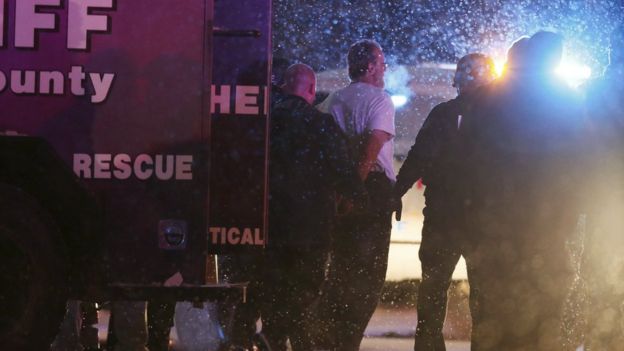
Suspect is taken into custody outside a Planned Parenthood centre in Colorado Springs, Colorado November 27, 2015

A man could be seen being taken into custody outside the centre
Colorado Springs Police Chief Peter Carey said five police officers were among the injured, who were being treated in local hospitals.
Police had sealed off streets around the centre as officers tried to make contact with the suspect.
"We did get officers inside the building," police Lt Catherine Buckley said.

What is Planned Parenthood?

  • A healthcare non-profit-making group with 59 affiliates and 700 clinics around the US
  • The largest single provider of abortion in the US
  • Its clinics provide many other healthcare services including cancer screening
  • Dates back to 1916 when social activist and nurse Margaret Sanger opened the first birth control and family planning centre in Brooklyn, New York
  • In the 1960s and 1970s, Planned Parenthood affiliates were at the fore of many court fights to make abortion legal
"They were able to shout to the suspect and make communication with him and at that point they were able to get him to surrender and he was taken into custody."
Police said the suspect had been seen carrying "some bags" into the building and teams were combing the area for possible explosives.
The suspect's car which was found nearby was also being checked for explosives, CNN reported.
 Armed police secure the scene outside a Planned Parenthood facility in Colorado Springs. 27 Nov 2015 
Armed police patrolled the streets outside the centre during the stand-off  
 
 People who escaped the centre were led to safety by police. 27 Nov 2015 
People who escaped the centre were led to safety by police
The manager of a nearby hair salon, Denise Speller, said she had heard as many as 20 gunshots in under five minutes.
She told a local newspaper she had seen one of two police officers appear to fall to the ground and the other attempt to get the wounded officer behind their police vehicle.
Police had told shoppers at a nearby centre to stay indoors.
In a statement, Planned Parenthood said it was not yet clear "if Planned Parenthood was in fact the target of this attack".
"Our concern is for the safety of our patients, staff and law enforcement," said its CEO, Vicki Cowart.
Planned Parenthood has been the focus of protests recently after an anti-abortion organisation secretly recorded a Planned Parenthood official discussing how to obtain aborted foetal tissue for medical research.
Pro-life advocates say this proves Planned Parenthood is selling foetal parts for profit - which is illegal - but this is disputed by the organisation.
New York's city police said it had deployed critical response vehicles to Planned Parenthood sites in the city because of the Colorado incident, but said there was no threat in the city.
Share:

Gunman Kills 3 In US Abortion Clinic Shootout

The suspect surrenders to police six hours after the start of the attack in which six officers and six civilians were shot.

COLORADO SHOOTING OZY LICANO
Video: 'He Aimed At Me And I Hit The Gas'
Three people including a police officer were killed and nine wounded when a gunman opened fire at a family planning centre in Colorado Springs.
The death of Garrett Swasey, 44, was announced "with great sorrow" by the Colorado Fraternal Order of Police.
He was from the University of Colorado, about 10 minutes away from the clinic, and had responded to a call to help city officers.
Police officer Garrett Swasey
Officer Swasey
Two civilians also died in hospital as a result of their injuries. Their identities are not yet known.
In all, six police and six civilians were shot in the attack at the Planned Parenthood building in Centennial Boulevard.
COLORADO ABORTIN CLINIC SHOOTING
Video: Colorado Abortion Clinic Shooting
They were taken to two local hospitals where the nine survivors are said to be in a good condition. None of the victims were patients or members of staff at the clinic.
"I want to convey to the loved ones of the victims: this is a terrible, terrible tragedy that occurred here in Colorado Springs today," Mayor John Suthers told reporters.
The standoff began shortly before midday local time on Friday and ended after six hours when the suspect gave himself up. He has been named as Robert Lewis Dear from North Carolina.
Colorado Springs police spokeswoman Catherine Buckley said the gunman had taken bags into the building, which was being searched amid fears they contained explosives.
She said he was armed with a "long weapon" with a shoulder stock such as a rifle, and some witnesses reported hearing automatic fire.
Many people were evacuated from the building but others were unable to get out.
Joan Motolinia said his sister, Jennifer, called him while hiding behind a table in the clinic and that he could hear gunfire in the background.
"She was telling me to take care of her babies because she could get killed," he said of the mother of three.
Quan Hoang, the owner of a nearby nail salon, told CNN that when he first heard shots fired he thought a local bank was being robbed.
"We see cops, SWAT, the bomb squad, a whole bunch of people just trying to take cover around the Planned Parenthood area," he said in a telephone interview.
"An officer came back in and said, 'Is everyone safe?' We asked him questions and he said they've barricaded him inside the Planned Parenthood and he was shooting out from the windows."
Planned Parenthood said it did not know if it was the target of the attack.
However, Vicki Cowart, president of its Colorado branch, said in a statement: "We share the concerns of many Americans that extremists are creating a poisonous environment that feeds domestic terrorism in this country."
Planned Parenthood operates hundreds of clinics nationwide providing services such as contraception, abortions and STD testing.
The non-profit organisation - which was rocked by claims it sells aborted foetal tissue for profit earlier this year - has been repeatedly targeted by pro-life activists.
Share:

Mali attack: Rocket kills three at UN base at Kidal

UN peacekeepers in eastern Mali (file image) 
Some 10,000 soldiers from dozens of different nations are currently serving in Mali under the UN banner
Three people have been killed in a rocket attack on a UN peacekeepers' base in northern Mali, the UN says.
Two UN peacekeepers from Guinea and a civilian contractor were killed in the attack in Kidal, officials said.
Eight days ago, gunmen attacked a hotel in the capital, Bamako, taking scores hostage. Nineteen people were killed.
The peacekeeping mission in Mali was approved in 2014 after France led a military campaign to drive out Islamist militants from the north.
The Minusma force comprises some 10,000 soldiers from dozens of different contributor countries - the majority from Mali's west African neighbours.
World's most dangerous peacekeeping mission
The UN mission - criticised by some at the time of its approval because there is no peace deal to support - has suffered more casualties than any other in recent years, with 56 troops killed.

Map 
Islamist militants are suspected of being behind Saturday's attack, in which 14 people were injured, several seriously, reports suggest.
"Our camp in Kidal was attacked early this morning by terrorists using rockets," said an official from the Minusma force.
 
Share:
Copyright © Emperor | Powered by Blogger Design by ronangelo | Blogger Theme by NewBloggerThemes.com